If your business imports into the British Virgin Islands, cost changes rarely arrive at a convenient time.
They usually appear while you are already:
- pricing a project,
- planning inventory,
- or deciding whether to place the next order.
That is why the proposed Tonnage Duty (Amendment) Bill, 2026 is worth watching now. The bill was one of six gazetted for public review in January 2026, which means it has already entered the public and business conversation in the Territory.
This article is not legal advice. It is a practical business view of:
- what has been proposed,
- what is still uncertain,
- and what sensible BVI importers should do next.
If you want the broader customs foundation around this topic, you can also read our guides to BVI Customs for Business Owners (Part 1) and Part 2.
What has actually been proposed?
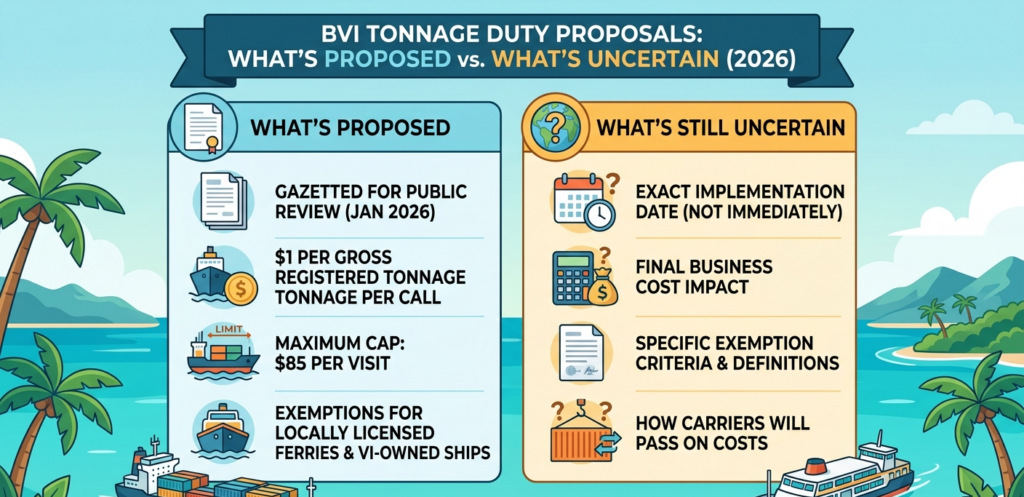
The official laws site lists the Tonnage Duty (Amendment) Bill, 2026, and the Virgin Islands Government confirmed that the bill was gazetted for public review in January. Public reporting on the debate says the proposal would charge $1 per gross registered tonnage per call, capped at $85 per visit, with exemptions for certain vessels, including some locally licensed ferries and some ships registered in the Virgin Islands and owned by Virgin Islands companies.
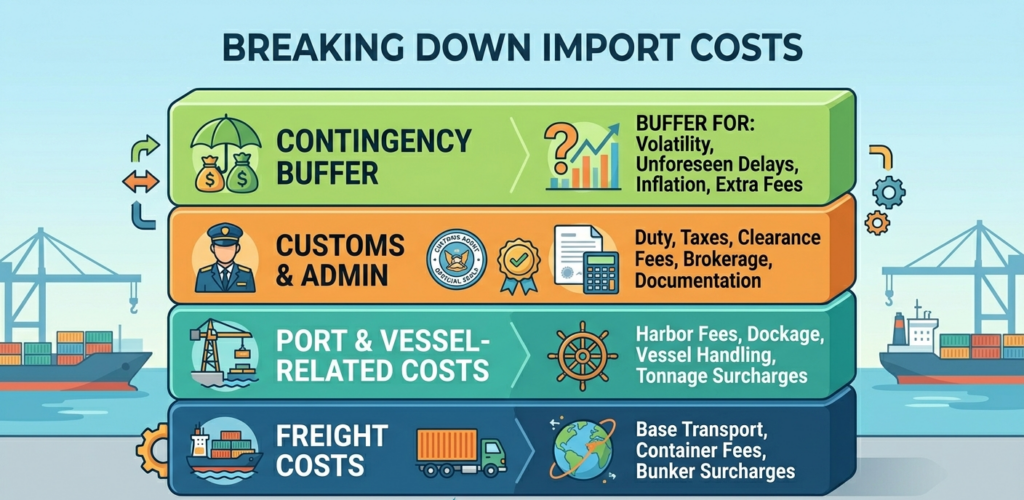
That matters because even relatively modest charges can affect the final cost structure of imported goods, especially when they sit on top of:
- freight,
- customs-related costs,
- inventory timing,
- and already tight operating margins.
What is still uncertain?
This is the most important part.
The proposal is real enough to watch — but that does not mean businesses should immediately assume the final cost impact on every future shipment.
According to public reporting, government officials said the measure is intended to improve collection efficiency and better align charges with vessel use. The same reporting also says the Premier indicated the measure would not be brought into force immediately, citing global economic conditions and concern about price pressure.
So the practical takeaway is:
- Yes, pay attention now.
- No, don’t overreact or recost everything blindly.
This is a planning issue, not a panic issue.
Why BVI importers should care now
For many BVI businesses, imported-cost pressure is already high.
The question is rarely whether one charge alone will break a deal.
The question is what happens when multiple moving parts stack together:
- freight volatility,
- supplier timing,
- customs risk,
- project deadlines,
- and local delivery pressure.
If you operate in hospitality, retail, fit-out, electricals, or project procurement, even a small shift can affect:
- margin,
- customer pricing,
- reorder timing,
- and delivery confidence.
That is why upstream planning matters.
This is also why we keep advising clients to treat Reliable Logistics as part of the buying decision, not something to think about after the order is placed.
What importers should do now
1. Stop planning around one “perfect” number
If your costing depends on one optimistic estimate, this is a good moment to tighten your process.
A better approach is to work with:
- a likely working case,
- a higher-cost case,
- and a small buffer for uncertainty.
We cover that planning mindset in more detail in BVI Customs for Business Owners (Part 2).
2. Review your routing and carrier assumptions
If vessel-related charging structures change, routing and call patterns may matter more than they do today.
This does not mean changing everything immediately. It means asking your logistics partners better questions:
- Could this affect carrier choice?
- Could it influence how costs are allocated?
- Does this change how we should time or consolidate shipments?
3. Tighten documentation and coordination
Periods of uncertainty make sloppy admin more expensive.
Now is a good time to sharpen:
- supplier documentation,
- broker handoff,
- product descriptions,
- and pre-shipment checks.
If your process still depends too much on scattered email threads, start with our Essential Import Documentation Checklist.
4. Watch the proposal without ignoring it
The bill is not irrelevant simply because it is not yet in force.
Good operators track proposed changes early because early awareness creates options:
- better pricing decisions,
- better timing,
- and fewer rushed reactions later.
The bigger lesson
This proposed tonnage duty discussion is part of a broader shift: importing into the BVI is becoming more strategic.
That is already visible elsewhere. In 2025, the Government announced zero customs duty on renewable energy and energy-efficient products from 1 September 2025 to 31 August 2030, including items like solar panels, EV charging infrastructure, and LED lighting.
In other words, some imported categories are being actively encouraged, while other cost structures are being reviewed and debated.
The lesson for business owners is not that everything is getting more expensive.
The lesson is that import economics are changing more actively than before.
That makes calm planning worth more.
The practical takeaway for BVI businesses
Here is the short version:
- The Tonnage Duty (Amendment) Bill, 2026 is a real proposal and worth watching.
- The final business impact is not yet something to assume blindly, especially given reporting that implementation is not immediate.
- This is the right time to improve your:
- cost planning,
- routing conversations,
- documentation discipline,
- and pre-shipment coordination.
If your team is approving purchase orders now, the best question is not:
“Has everything changed?”
It is:
“Is our import process strong enough to absorb change without hurting margin or timing?”
That is the better question.
How AsiaCaribbean can help
AsiaCaribbean is not a law firm, and we are not His Majesty’s Customs.
What we do is help BVI businesses prepare for imports from Asia with:
- stronger pre-shipment planning,
- clearer supplier-to-broker coordination,
- calmer documentation workflows,
- and more realistic thinking around timelines and costs.
If you are reviewing an order now and want a second set of eyes on the planning side, book a BVI ImpoYour Roadmap to Seamless Imports: The 5 Key Stagesrt Readiness Review before the cargo moves.
That is usually the cheapest moment to solve an expensive problem.