BVI Customs Clearance Services: Navigating Road Town Import Protocols
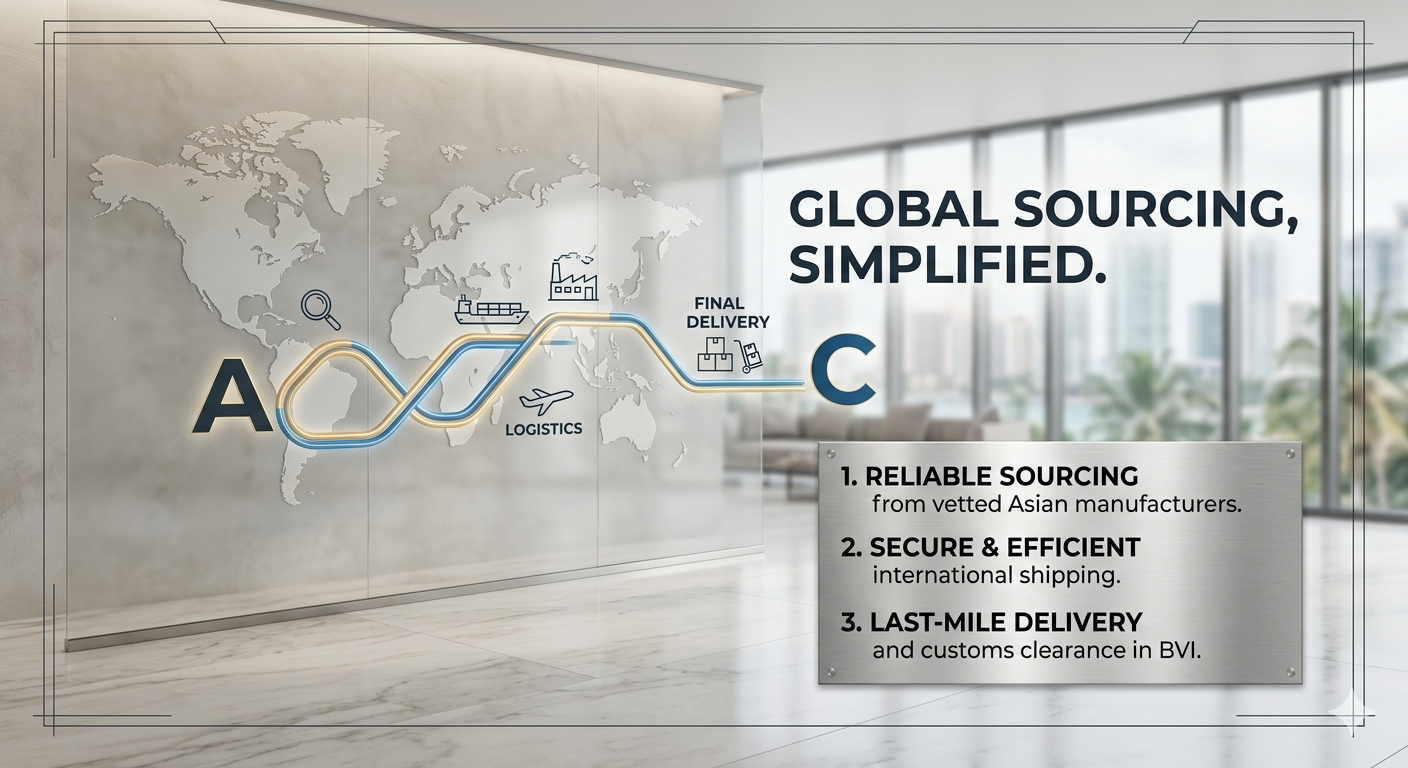
Avoid import delays in Road Town with expert BVI customs clearance services and HS code optimization. Asiacaribbean manages the entire brokerage process—from ASYCUDA World documentation to final port clearing—for businesses sourcing from Asia.
If you run a business in the British Virgin Islands, almost every import from Asia passes through His Majesty’s Customs. This article gives you a business-level overview of five practical essentials—so you can plan more clearly, ask better questions, and reduce costly surprises. It is not legal, tax, or professional customs advice.
MPORTANT DISCLAIMER
This article provides general educational information for business owners and managers in the British Virgin Islands.
It is not:
- legal advice
- tax advice
- or professional customs advice
Customs regulations are complex, can change, and may be applied differently depending on:
- what you are importing
- your role (merchant, private importer, etc.)
- the specific circumstances of your shipment
Nothing in this article should be used to:
- interpret BVI law
- predict exactly how His Majesty’s Customs will treat a particular shipment
- calculate the precise duties or taxes you will pay
For any legal or regulatory question, you should rely on:
- His Majesty’s Customs – Government of the Virgin Islands
- a licensed BVI customs broker
- a customs or trade attorney
Official government sources for customs information include:
- His Majesty’s Customs – Department page
– https://bvi.gov.vg/departments/her-majestys-customs- “Collection of Import Duties” – service description (airport & seaport)
– https://bvi.gov.vg/content/collection-import-duties- Customs Management and Duties Act, 2010 (plus amendments) – PDF
– https://bvi.gov.vg/sites/default/files/resources/Customs%20Management%20and%20Duties%20Act%202010%20plus%20Ammendments.pdf- Virgin Islands Laws Online (for specific amendment Acts, e.g. 2025)
– https://laws.gov.vgThis article is written from a business and logistics perspective only. It is meant to help you think more clearly and ask better questions—not to replace official sources.
Why This Matters for BVI Businesses
If you run a business in the BVI, imports are part of daily life:
- retail stock and inventory
- equipment for hotels, villas, and restaurants
- construction materials and fixtures
- components for industrial or technical operations
Every shipment passes through BVI Customs.
When you don’t plan for that, you tend to face:
- surprise charges
- delays you didn’t build into your schedule
- difficult conversations with customers and project teams
When you do plan, customs becomes another managed process in your business—still important and serious, but far less stressful.
This Part 1 article focuses on three foundations:
- Seeing customs as a process
- Treating HS codes as critical data
- Organising your documentation
In Part 2, you’ll look at where friction usually appears and how to plan your cost envelope calmly.
1. See Customs as a Process, Not a Mystery
From a business point of view, almost every import follows three broad phases:
Phase 1 – Before shipment
- You agree products, quantities and prices with your supplier.
- You share details with your customs broker or shipping agent.
- They prepare the necessary declarations and entries based on the information you provide.
Phase 2 – When the goods arrive in the BVI
- Your broker submits entries and supporting documents to His Majesty’s Customs.
- Customs reviews the information, may ask questions, and decides how the shipment should be treated under the law.
- Where applicable, duties and taxes are assessed.
Phase 3 – After assessment
- Duties and taxes (if any) are paid through your broker or as directed.
- Customs authorises release.
- Goods move into your warehouse, store, or project site.
The detailed legal steps, timelines and requirements are set by Customs and the legislation they enforce. They can evolve, and may differ depending on:
- port of entry
- type of goods
- inspections or additional approvals required
From a business perspective, the most important points are:
- Your broker must have accurate and consistent information from you and your supplier.
- You should understand where delays typically arise, so you can help avoid them.
Questions to ask your broker or Customs:
- “For the types of goods I import, what does the usual process look like from arrival to release?”
- “Where do you most often see delays—and what usually causes them?”
- “What can we prepare before shipment that will make your job easier on arrival?”
At AsiaCaribbean Import, we don’t try to speak for Customs. Instead, we help align:
- what suppliers say they are shipping,
- what your broker expects to declare,
- and what your internal team believes they ordered,
so everyone is working from the same information.
2. Treat HS Codes as Critical Business Data
Every product that crosses a border is identified under a Harmonised System (HS) code.
That code:
- provides a standard description of the product, and
- connects your goods to the customs treatment that may apply to that category.
Two shipments that look similar to you can fall under different HS codes and be treated differently by Customs.
This article will not tell you which HS code you should use. That decision belongs to:
- His Majesty’s Customs, and
- qualified BVI customs brokers or legal advisors.
What you can do, safely and usefully, is treat HS codes as non-negotiable business data, not an afterthought.
Practical moves:
- Don’t leave HS code decisions to the last minute.
- Build HS code considerations into your purchasing and planning, especially for large or recurring imports.
Questions to ask before committing to a large order:
- “Which HS codes are we planning to use for each product?”
- “Can you (broker) confirm those codes and short descriptions in writing?”
- “If Customs disagrees with a proposed classification, what usually happens and how can we prepare for that scenario?”
AsiaCaribbean can help you gather the right technical information from factories—spec sheets, product descriptions, composition details—so your broker has what they need to make a well-informed classification. We do not override or replace Customs’ decisions on HS codes.
3. Build a Documentation System, Not Just a Stack of PDFs
Many customs problems are, in reality, paperwork problems:
- mismatched values
- inconsistent descriptions
- missing certificates
Instead of trying to remember every possible form, it’s more practical to create a simple documentation system for your business.
Common documents your broker will often work with
The exact documents required for your shipment depend on:
- the type of goods,
- your importer status, and
- current BVI regulations.
However, most commercial imports will involve some combination of:
- Customs entry / declaration forms
- Commercial invoice(s) – with product descriptions, quantities, unit prices and totals
- Bill of lading or air waybill – from the carrier
- Packing list – showing what is in each package
- HS code / classification list – for each line item
- Certificate of origin – where relevant
- Import licences or permits – for controlled goods (e.g. certain chemicals, food items, pharmaceuticals, telecom or specialised equipment)
- Compliance / safety certificates – such as electrical safety, health or sanitary approvals
For some products, additional documents may be required. Only your customs broker and His Majesty’s Customs can confirm the full set needed for your shipment.
From a business standpoint, aim for clarity and consistency:
- Do all documents show the same quantities and values?
- Are product descriptions clear and consistent (supplier invoice, packing list, broker entry)?
- Are there obvious gaps (for example, missing origin information or missing certificates)?
Questions to ask your broker:
- “For these specific products, which documents do you always need from us?”
- “Are there any certificates, permits or details that importers often overlook for this category?”
- “Can we create a standard documentation checklist for our future shipments?”
AsiaCaribbean frequently helps clients:
- create that internal checklist, and
- review supplier documents for obvious mismatches
before cargo leaves Asia. That doesn’t replace Customs or your broker—but it reduces avoidable friction.
Official Resources – Customs Basics
For current, official customs information, please refer to:
- His Majesty’s Customs – Government of the Virgin Islands
Department page, contacts, publications and forms:
https://bvi.gov.vg/departments/her-majestys-customs - Collection of Import Duties – Service Description
Official summary of the import duties process at airport and seaport:
https://bvi.gov.vg/content/collection-import-duties - Customs Management and Duties Act, 2010 (plus amendments)
Consolidated PDF published by the Government of the Virgin Islands:
https://bvi.gov.vg/sites/default/files/resources/Customs%20Management%20and%20Duties%20Act%202010%20plus%20Ammendments.pdf - Virgin Islands Laws Online
Official repository for Acts and amendments, including the latest Customs-related Acts:
https://laws.gov.vg
This AsiaCaribbean article is only a business overview. If anything in this article appears to conflict with official government information, the official government source always prevails.
What’s Next – Costs, Delays & Planning Ahead
In Part 1, you’ve focused on:
- understanding customs as a process,
- recognising HS codes as critical data, and
- building a basic documentation system.
These are the foundations.
In Part 2, you’ll look at:
- where friction commonly shows up (classification, valuation, origin and regulated goods),
- how to think about your cost envelope without pretending to be Customs, and
- how AsiaCaribbean can support you within those limits.
👉 Continue reading: BVI Customs for Business Owners (Part 2): Costs, Delays & Planning Ahead